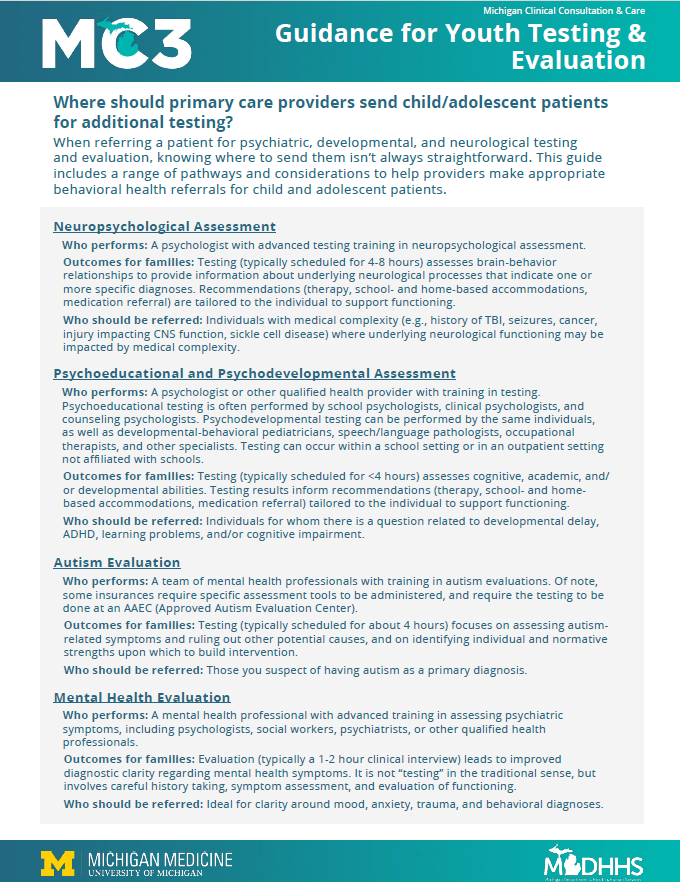
Where should primary care providers send child/adolescent patients for additional testing?
When referring a patient for psychiatric, developmental, and neurological testing and evaluation, knowing where to send them isn’t always straightforward. This guide includes a range of pathways and considerations to help providers make appropriate behavioral health referrals for child and adolescent patients.
Who performs: A psychologist with advanced testing training in neuropsychological assessment.
Outcomes for families: Testing (typically scheduled for 4-8 hours) assesses brain-behavior relationships to provide information about underlying neurological processes that indicate one or more specific diagnoses. Recommendations (therapy, school- and home-based accommodations, medication referral) are tailored to the individual to support functioning.
Who should be referred: Individuals with medical complexity (e.g., history of TBI, seizures, cancer, injury impacting CNS function, sickle cell disease) where underlying neurological functioning may be impacted by medical complexity.
Psychoeducational and Psychodevelopmental Assessment
Who performs: A psychologist or other qualified health provider with training in testing. Psychoeducational testing is often performed by school psychologists, clinical psychologists, and counseling psychologists. Psychodevelopmental testing can be performed by the same individuals, as well as developmental-behavioral pediatricians, speech/language pathologists, occupational therapists, and other specialists. Testing can occur within a school setting or in an outpatient setting not affiliated with schools.
Outcomes for families: Testing (typically scheduled for <4 hours) assesses cognitive, academic, and/or developmental abilities. Testing results inform recommendations (therapy, school- and home-based accommodations, medication referral) tailored to the individual to support functioning.
Who should be referred: Individuals for whom there is a question related to developmental delay, ADHD, learning problems, and/or cognitive impairment.
Autism Evaluation
Who performs: A team of mental health professionals with training in autism evaluations. Of note, some insurances require specific assessment tools to be administered, and require the testing to be done at an AAEC (Approved Autism Evaluation Center).
Outcomes for families: Testing (typically scheduled for about 4 hours) focuses on assessing autism-related symptoms and ruling out other potential causes, and on identifying individual and normative strengths upon which to build intervention.
Who should be referred: Those you suspect of having autism as a primary diagnosis.
Mental Health Evaluation
Who performs: A mental health professional with advanced training in assessing psychiatric symptoms, including psychologists, social workers, psychiatrists, or other qualified health professionals.
Outcomes for families: Evaluation (typically a 1-2 hour clinical interview) leads to improved diagnostic clarity regarding mental health symptoms. It is not “testing” in the traditional sense, but involves careful history taking, symptom assessment, and evaluation of functioning.
Who should be referred: Ideal for clarity around mood, anxiety, trauma, and behavioral diagnoses.
Decision Tree for Evaluation
Is Autism your primary reason for referral?
YES
NO
Does the child have medical complexity?
Does the child have medical complexity?
YES
NO
YES
NO
Recommend Autism testing at a medical AAEC
Recommend Autism testing anywhere (AAEC if required by insurance)
Recommend neuropsych testing
What is the primary referral question?
ADHD
Learning problems
Mental health
If not complex, consider using Conners and/or Vanderbilt forms to diagnose in office without referral.
If more complex, consider psychoeducational testing referral (not at school).
Consider school-based testing (can be requested by family).
If ADHD is a possible rule out, consider psychoeducational testing referral (not at school).