Generic selectors
Exact matches only
Search in title
Search in content
Post Type Selectors
page
post

Practical Strategies to Support Youth at Risk for Behavioral Escalation

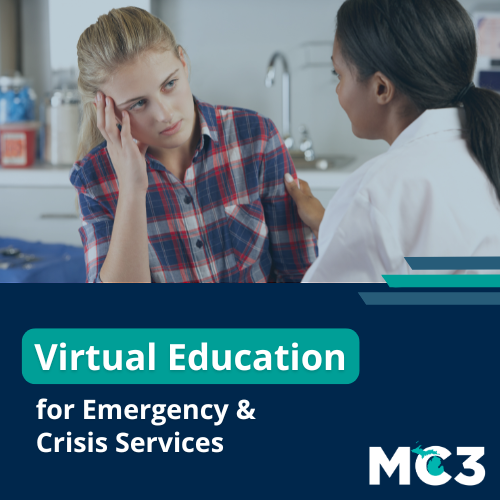
Virtual Education for Emergency & Crisis Services

Practical Strategies to Support Youth at Risk for Behavioral Escalation is an 11-part virtual education series from MC3 Emergency & Crisis Services designed for professionals working with youth in acute, emergency, and crisis settings. These educational modules feature expert presenters covering essential topics like trauma-informed care, behavioral dysregulation, non-pharmacologic and pharmacologic strategies, coping skills, caring for youth with autism and other neurodevelopmental disabilities with aggression risk, and systems solutions.

Each session offers actionable insights and practical clinical pearls. Complete the modules to strengthen your practical toolkit for supporting youth at risk for behavioral dysregulation! CMEs are available.

Target audience

This series is designed for healthcare professionals working with youth in acute, emergency, and crisis settings, such as ED sites and CMHs.

decorative figure.

Resources from educational modules

Download and share the resources referenced throughout these training modules on our Emergency & Crisis Services Resources page.

Jump to a module

Module details

1. Trauma-Informed Care Practices for Pediatric Youth and Families

Learning objectives

  • Recognize how psychological trauma commonly presents in children and adolescents in the ED, including behavioral and somatic symptoms.
  • Apply core trauma-informed care principles to reduce distress, escalation, and retraumatization in pediatric ED encounters.
  • Use brief, ED-feasible strategies to enhance safety, communication, and engagement with children, adolescents, and caregivers.

Continuing education credits available: The Minnesota Medical Association designates this activity for a maximum of .50 AMA PRA Category 1 Credit(s)™.

Presenter

Polly Gipson Allen.
Polly Gipson Allen, Ph.D.

Clinical Associate Professor, Department of Psychiatry, Michigan Medicine

2. Introduction to Behavioral Dysregulation: Why does it happen?

Learning objectives

  • Explain the underlying factors contributing to behavioral dysregulation in youth.
  • Recognize the underlying causes of behavioral dysregulation and apply a root-cause approach when planning interventions for escalating behaviors.

Continuing education credits available: The Minnesota Medical Association designates this activity for a maximum of .50 AMA PRA Category 1 Credit(s)™.

Presenter

Nasuh Malas
Nasuh Malas, M.D., M.P.H.

Clinical Professor, Departments of Psychiatry and Pediatrics, Michigan Medicine

3. Introduction to Behavioral Dysregulation: What do we do about it?

Learning objectives

  • Summarize evidence-based interventions for managing behavioral dysregulation in pediatric patients.
  • Apply clinical reasoning to select appropriate management strategies based on the underlying factors contributing to behavioral dysregulation.

Continuing education credits available: The Minnesota Medical Association designates this activity for a maximum of .50 AMA PRA Category 1 Credit(s)™.

Presenter

Nasuh Malas
Nasuh Malas, M.D., M.P.H.

Clinical Professor, Departments of Psychiatry and Pediatrics, Michigan Medicine

4. Behavioral Dysregulation Bundle – Non-Pharmacologic Care Strategies

Learning objectives

  • Outline non-pharmacologic strategies, including care algorithms and behavioral plans, for supporting youth with behavioral dysregulation.
  • Demonstrate the implementation of staff care practices and techniques to promote positive behavioral outcomes.

Continuing education credits available: The Minnesota Medical Association designates this activity for a maximum of .50 AMA PRA Category 1 Credit(s)™.

Presenters

Crystal Cederna
Crystal Cederna, Psy.D.

Associate Professor, College of Human Medicine, Michigan State University

Sarah Wise, B.S.N., R.N., NE-BC

Emergency & Crisis Services Consultation Project Manager, MC3, Michigan Medicine

5. Behavioral Dysregulation Bundle – Pharmacologic Care Strategies

Learning objectives

  • Review the BETA guidelines and clinical decision flow charts for pharmacological management of behavioral dysregulation.
  • Evaluate the risks and benefits of psychopharmacologic interventions in pediatric behavioral care.

Continuing education credits available: The Minnesota Medical Association designates this activity for a maximum of .50 AMA PRA Category 1 Credit(s)™.

Presenter

Nasuh Malas
Nasuh Malas, M.D., M.P.H.

Clinical Professor, Departments of Psychiatry and Pediatrics, Michigan Medicine

6. Coping Workbook – Foundational Skills

Learning objectives

  • Illustrate foundational coping skills such as square breathing, grounding techniques, and use of the emotions thermometer.
  • Explore applying foundational skills from the Coping Workbook to real-life pediatric care scenarios.

Continuing education credits available: The Minnesota Medical Association designates this activity for a maximum of .50 AMA PRA Category 1 Credit(s)™.

Presenter

Nasuh Malas
Nasuh Malas, M.D., M.P.H.

Clinical Professor, Departments of Psychiatry and Pediatrics, Michigan Medicine

7. Coping Workbook – Second Line Skills

Learning objectives

  • Integrate advanced coping strategies, including WISE MIND, Ride the Wave, and I-Statements, into clinical practice.
  • Develop personalized safety planning and CBT-based interventions for pediatric patients using the Coping Workbook.

Continuing education credits available: The Minnesota Medical Association designates this activity for a maximum of .50 AMA PRA Category 1 Credit(s)™.

Presenters

Crystal Cederna
Crystal Cederna, Psy.D.

Associate Professor, College of Human Medicine, Michigan State University

8. Lived Experience and the Use of a Crisis Navigator

Learning objectives

  • Recognize the value and impact of lived experience in guiding crisis intervention strategies for youth.
  • Assess how a crisis navigator can enhance support for pediatric patients and families during behavioral health crises.

Continuing education credits available: The Minnesota Medical Association designates this activity for a maximum of .50 AMA PRA Category 1 Credit(s)™.

Presenters

Carla Pretto.
Dianna Robinson
Carla Pretto, R.N.

Executive Director, Association for Children’s Mental Health

Dianna Robinson, CTPD

Parent Advisory Committee Coordinator, Association for Children’s Mental Health

9. Understanding Neurodevelopmental Disabilities in Emergency Care

Learning objectives

  • Identify key diagnostic features and characteristics of neurodevelopmental disabilities that may influence communication, behavior, sensory processing, emotional regulation, and engagement in emergency care settings.
  • Apply a developmentally informed approach to patient assessment by integrating developmental history, baseline functioning, caregiver input, environmental factors, and presenting clinical concerns to build a more complete clinical picture.

Continuing education credits available: The Minnesota Medical Association designates this activity for a maximum of .50 AMA PRA Category 1 Credit(s)™.

Presenter

Nasuh Malas
Nasuh Malas, M.D., M.P.H.

Clinical Professor, Departments of Psychiatry and Pediatrics, Michigan Medicine

10. Developmentally-Informed Crisis Response and Behavioral Support

Learning objectives

  • Implement developmentally informed strategies during behavioral escalation or periods of distress to support patient de-escalation, reduce environmental and communication barriers, and promote safety for the patient, family, and care team.
  • Incorporate neurodevelopmental needs, medication considerations, historical response to treatment, and comprehensive care planning to guide individualized, tailored interventions in the emergency and crisis care setting.

Continuing education credits available: The Minnesota Medical Association designates this activity for a maximum of .50 AMA PRA Category 1 Credit(s)™.

Presenter

Hannah Reynard
Hannah Reynard, D.O., M.Sc.

Clinical Assistant Professor, Department of Psychiatry, Michigan Medicine

11. Systems Solutions for Youth At-Risk for Behavioral Dysregulation

Learning objectives

  • Analyze systemic challenges and potential solutions for supporting youth at-risk for behavioral dysregulation.
  • Review practical strategies for preventing and responding to behavioral dysregulation in the emergency department setting.

Continuing education credits available: The Minnesota Medical Association designates this activity for a maximum of .50 AMA PRA Category 1 Credit(s)™.

Presenter

Victor Hong
Victor Hong, M.D.

Clinical Associate Professor, Department of Psychiatry, Michigan Medicine

Accreditation and designation

This activity has been planned and implemented in accordance with the accreditation requirements and policies of the Accreditation Council for Continuing Medical Education (ACCME) through the joint providership of the Minnesota Medical Association and MPHI. The Minnesota Medical Association (MMA) is accredited by the Accreditation Council for Continuing Medical Education to provide continuing medical education for physicians.

The Minnesota Medical Association designates this activity for a maximum of 5.50 AMA PRA Category 1 Credit(s)™. Physicians should claim only the credit commensurate with the extent of their participation in the activity. This CME approval expires on 11/15/2029.

To receive CME or a Certificate of Completion, learners must complete the online evaluation below.

Minnesota Medical Association logo circle with heart rate line

Financial disclosures

None of the planners or Faculty for this educational activity have relevant financial relationship(s) to disclose with ineligible companies whose primary business is producing, marketing, selling, re-selling, or distributing healthcare products used by or on patients.