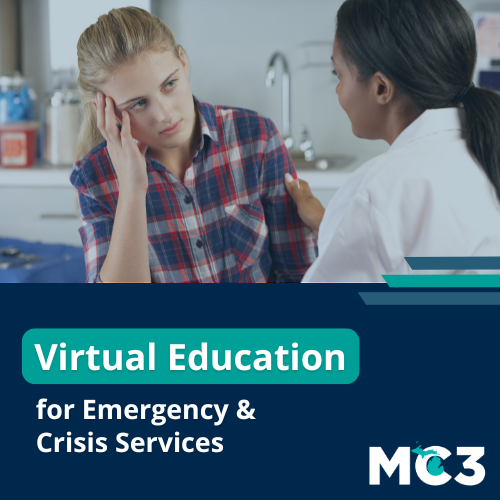
Practical Strategies to Support Youth at Risk for Behavioral Escalation
Virtual Education for Emergency & Crisis Services
Web-based virtual training | There is no fee to attend this activity
Practical Strategies to Support Youth at Risk for Behavioral Escalation is a new webinar series from MC3 Emergency & Crisis Services designed for professionals working with youth in acute, emergency, and crisis settings. Beginning March 17 then running biweekly starting March 24 on Tuesday mornings at 9 a.m. ET, these 30-minute talks (followed by an optional 15-minute Q&A session) feature expert presenters covering essential topics like trauma-informed care, behavioral dysregulation, non-pharmacologic and pharmacologic strategies, coping skills, caring for youth with autism and other neurodevelopmental disabilities with aggression risk, and systems solutions.
Each session will offer actionable insights and practical clinical pearls. Join us to strengthen your practical toolkit for supporting youth at risk for behavioral dysregulation!
Target audience
This series is designed for health care professionals working with youth in acute, emergency, and crisis settings, such as ED sites and CMHs.
Accessibility
Please let us know how we can ensure that this educational series is inclusive for you. We will enable Live Auto Transcript for each session. If you have other accommodations or access needs that we can help facilitate, please get in touch with the MC3 Program Team at [email protected], preferably at least one week in advance of the sessions you plan to attend.
What participants are saying:
“I appreciate the time-limited session with concise info and efficient delivery. It’s better to have small sound-bites and get the info than miss a longer session and info due to schedules.”
Register for training series
Complete the registration form at the bottom of this page to register for this training series.
Session details:
March 17: Trauma-Informed Care Practices for Pediatric Youth and Families (Session 1)
March
17
9–9:30 a.m. ET
Learning objectives
Recognize how psychological trauma commonly presents in children and adolescents in the ED, including behavioral and somatic symptoms.
Apply core trauma-informed care principles to reduce distress, escalation, and retraumatization in pediatric ED encounters.
Use brief, ED-feasible strategies to enhance safety, communication, and engagement with children, adolescents, and caregivers.
Clinical Associate Professor, Department of Psychiatry, Michigan Medicine
March 24: Behavioral Dysregulation: Why does it happen and what do we do about it? (Session 2)
March
24
9–9:30 a.m. ET
Learning objectives
Explain the underlying factors contributing to behavioral dysregulation in youth.
Summarize evidence-based interventions for managing behavioral dysregulation in pediatric patients.
Presenters
Nasuh Malas, M.D., M.P.H.
Clinical Professor, Departments of Psychiatry and Pediatrics, Michigan Medicine
Victor Hong, M.D.
Clinical Associate Professor, Department of Psychiatry, Michigan Medicine
April 14: Behavioral Dysregulation Bundle – Non-Pharmacologic Care Strategies (Session 3)
April
14
9–9:30 a.m. ET
Learning objectives
Outline non-pharmacologic strategies, including care algorithms and behavioral plans, for supporting youth with behavioral dysregulation.
Demonstrate the implementation of staff care practices and techniques to promote positive behavioral outcomes.
Presenters
Crystal Cederna, Psy.D.
Associate Professor, College of Human Medicine, Michigan State University
Sarah Wise, B.S.N., R.N., NE-BC
Emergency & Crisis Services Consultation Project Manager, MC3, Michigan Medicine
April 28: Behavioral Dysregulation Bundle – Pharmacologic Care Strategies (Session 4)
April
28
9–9:30 a.m. ET
Learning objectives
Review the BETA guidelines and clinical decision flow charts for pharmacological management of behavioral dysregulation.
Evaluate the risks and benefits of psychopharmacologic interventions in pediatric behavioral care.
Presenter
Nasuh Malas, M.D., M.P.H.
Clinical Professor, Departments of Psychiatry and Pediatrics, Michigan Medicine
May 12: Coping Workbook – Foundational Skills (Session 5)
May
12
9–9:30 a.m. ET
Learning objectives
Illustrate foundational coping skills such as square breathing, grounding techniques, and use of the emotions thermometer.
Explore applying foundational skills from the Coping Workbook to real-life pediatric care scenarios.
Presenter
Nasuh Malas, M.D., M.P.H.
Clinical Professor, Departments of Psychiatry and Pediatrics, Michigan Medicine
May 26: Coping Workbook – Second Line Skills (Session 6)
May
26
9–9:30 a.m. ET
Learning objectives
Integrate advanced coping strategies, including WISE MIND, Ride the Wave, and I-Statements, into clinical practice.
Develop personalized safety planning and CBT-based interventions for pediatric patients using the Coping Workbook.
Presenters
Crystal Cederna, Psy.D.
Associate Professor, College of Human Medicine, Michigan State University
June 9: Lived Experience and the Use of a Crisis Navigator (Session 7)
June
9
9–9:30 a.m. ET
Learning objectives
Recognize the value and impact of lived experience in guiding crisis intervention strategies for youth.
Assess how a crisis navigator can enhance support for pediatric patients and families during behavioral health crises.
Presenters
Carla Pretto, R.N.
Executive Director, Association for Children’s Mental Health
Dianna Robinson, CTPD
Parent Advisory Committee Coordinator, Association for Children’s Mental Health
June 23: Special Populations: Youth with Autism and Neurodevelopmental Disability (Session 8)
June
23
9–9:30 a.m. ET
Learning objectives
Identify unique behavioral health needs of youth with autism and neurodevelopmental disabilities.
Apply tailored care strategies to improve outcomes for youth with autism and neurodevelopmental disabilities.
Presenters
Hannah Reynard, D.O., M.Sc.
Clinical Assistant Professor, Department of Psychiatry, Michigan Medicine
Nasuh Malas, M.D., M.P.H.
Clinical Professor, Departments of Psychiatry and Pediatrics, Michigan Medicine
July 14: Systems Solutions for Youth At-Risk for Behavioral Dysregulation Including Autism Friendly Care Strategies (Session 9)
July
14
9–9:30 a.m. ET
Learning objectives
Analyze systemic challenges and potential solutions for supporting youth at-risk for behavioral dysregulation.
Review autism-friendly care practices and their practical applications in the emergency department setting.
Presenters
Nasuh Malas, M.D., M.P.H.
Clinical Professor, Departments of Psychiatry and Pediatrics, Michigan Medicine
Victor Hong, M.D.
Clinical Associate Professor, Department of Psychiatry, Michigan Medicine
July 28: Applying Trauma-Informed Care Practices: Reviewing a Case Study, Part 1 (Session 10)
July
28
9–9:30 a.m. ET
Learning objectives
Apply 12 core concepts as conceptual lenses to frame information and guide critical reasoning about a case study.
Identify ecological factors hypothesized to influence children’s traumatic experiences and contribute to their post-traumatic adjustment.
Presenter
Polly Gipson Allen, Ph.D.
Clinical Associate Professor, Department of Psychiatry, Michigan Medicine
August 11: Applying Trauma-Informed Care Practices: Reviewing a Case Study, Part 2 (Session 11)
August
11
9–9:30 a.m. ET
Learning objectives
Incorporate relevant ecological factors into a case conceptualization and use that framework to evaluate the hypothesized contributions of different case factors and guide case-related reasoning.
Use critical reasoning to make judgments about the relative impact of various factors hypothesized to influence a child’s traumatic experience and post-traumatic adjustment.
Presenter
Polly Gipson Allen, Ph.D.
Clinical Associate Professor, Department of Psychiatry, Michigan Medicine
August 25: Applying Trauma-Informed Care Practices: Reviewing a Case Study, Part 3 (Session 12)
August
25
9–9:30 a.m. ET
Learning objectives
Clearly and accurately communicate appropriate trauma information to fellow professionals, clients, and family members within and across settings.
Apply a trauma-informed conceptual lens to real-world aspects of professional practice, including assessment, case management, and treatment planning.
Presenter
Polly Gipson Allen, Ph.D.
Clinical Associate Professor, Department of Psychiatry, Michigan Medicine
Please complete the form below to register for this training series. We encourage you to attend as many sessions as you can. We will share the materials and recordings from sessions 1–9 with all registrants. Sessions 10–12 will not be recorded due to their highly interactive nature.
This resource is supported by the Health Resources and Services Administration (HRSA) of the U.S. Department of Health and Human Services (HHS) as part of an award (Award Number: 2 U4CMC32321-06-01) totaling $1,016,880 with 20% financed with State of Michigan resources. The contents are those of the author(s) and do not necessarily represent the official views of, nor an endorsement, by HRSA, HHS, or the U.S. Government. For more information, please visit HRSA.gov.