

No Comments |
Kara Kucinski |
- Dec 15, 2025
Video 5: Emergency Department and Hospital Considerations
Youth Suicide Prevention Video Series
Video length: 18 minutes
Video Chapters
Click on the three lines in the upper left corner to see chapter information or reference the chapter table of contents below to navigate to specific chapters.
- Introduction (0:43–3:53)
- Screening & risk assessment (3:54–5:55)
- Safety planning (5:56–6:50)
- Care (6:51–12:05)
- Admissions process (12:06–13:08)
- Brief interventions (13:09–15:28)
- Education and information for caregivers (15:29–16:05)
- Referrals (16:06–17:55)
Presenter
Nasuh Malas, M.D., M.P.H., Child & Adolescent Psychiatrist, University of Michigan
Objectives
- Educate emergency department and hospital providers about the prevalence and seriousness of youth suicide, emphasizing the importance of systematic screening, risk assessment, and management of suicide risk
- Encourage the consistent use of comprehensive, evidence-based strategies, like Safety Planning and Lethal Means Counseling, to provide personalized care to youth experiencing suicidal ideation
- Stress the importance of coordinated care efforts involving emergency department staff, community support organizations, and family members to ensure ongoing support for youth at risk
Resources
Resources Mentioned in Video
- Zero Suicide Children’s Hospitals Toolkit
- Action Alliance Emergency Department Best Practices – Care Transitions for Individuals with Suicide Risk
- ASQ BSSA (Ask Suicide Screening Questions Brief Suicide Safety Assessment)
- Stanley Brown Safety Plan
- AAP CALM for Pediatric Providers
- Means Matter
- Be SMART
- Bullet Points Project
- Safety products:
- National Alliance on Mental Illness (NAMI)
- TRAILS feelings thermometer
- TIPP (temperature, intense exercise, paced breathing, progressive muscle relaxation)
- 5-4-3-2-1 Coping Strategy
- STOPP Worksheet
- American Foundation for Suicide Prevention (AFSP)
- 988 Lifeline 24/7/365 | Call, Text, Chat
Other Resources
References
Asarnow JR, Babeva K, Horstmann E. The Emergency Department: Challenges and Opportunities for Suicide Prevention. Child Adolesc Psychiatr Clin N Am. 2017 Oct;26(4):771-783
Ambrose AJH, Prager LM. Suicide Evaluation in the Pediatric Emergency Setting. Child Adolesc Psychiatr Clin N Am. 2018 Jul;27(3):387-397
Vaughn LM, Sunny CE, Lindquist-Grantz R, King C, Brent D, Boyd S, Grupp-Phelan J. Successful Suicide Screening in the Pediatric Emergency Department: Youth, Parent, Researcher, and Clinician Perspectives. Arch Suicide Res. 2020;24(sup1):124-141
National Allicance for Suicide Prevention. Emergency Department Best Practices. https://theactionalliance.org/sites/default/files/aa-edbest_practices-2024-final_0.pdf
Jensen MV, Gallagher K, O’Driscoll M, Østervang C, Christiansen E, Stenager E. Suicide Prevention Interventions in the Emergency Department: A Scoping Review. J Emerg Nurs. 2025 Nov;51(6):1097-1113.
Miller IW, Camargo CA Jr, Arias SA, Sullivan AF, Allen MH, Goldstein AB, Manton AP, Espinola JA, Jones R, Hasegawa K, Boudreaux ED; ED-SAFE Investigators. Suicide Prevention in an Emergency Department Population: The ED-SAFE Study. JAMA Psychiatry. 2017 Jun 1;74(6):563-570. doi: 10.1001/jamapsychiatry.2017.0678. PMID: 28456130; PMCID: PMC5539839.
EDC Zero Suicide Institute. Zero Suicide Toolkit for Children’s Hospitals. https://zerosuicide.edc.org/toolkit/toolkit-adaptations/children
Text or call 988 for 24/7 judgment-free support for mental health, substance use, and more. Access available for Deaf/HoH and Spanish speakers. Visit https://988lifeline.org/ to chat or learn more.
No Comments |
Kara Kucinski |
- Dec 15, 2025
Video 4: Lethal Means Safety
Youth Suicide Prevention Video Series
Video length: 21 minutes
Video Chapters
Click on the three lines in the upper left corner to see chapter information or reference the chapter table of contents below to navigate to specific chapters.
- Introduction to lethal means safety (1:05–3:14)
- Virtual parent appointment (Note: “Mr. Peterson” is an actor and not an actual parent) (3:15–12:24)
- Types of lethal means and safe storage (12:25–19:33)
- Additional steps to support means safety (19:34–20:55)
Presenter
Alejandra Arango, Ph.D., Child Psychologist, University of Michigan
Objectives
- Recognize the importance of lethal means safety counseling
- Learn strategies for effective communication with caregivers about lethal means safety
- Develop a plan for removing or storing lethal means that is tailored for each family
Resources
Resources Mentioned in Video
- Familiarize yourself with firearm storage laws in your state and use this information to support discussions with caregivers, as needed. For example, information about Michigan firearm storage requirements and penalties can be found at Firearm Storage Penalties
Other Resources
- Suicide prevention in health care settings:
- Suicide warning signs
- Zero Suicide, Counseling Access to Lethal Means (CALM) online course
- AAP CALM for pediatric providers
- Institute for Fireman Injury Prevention ERPO (Extreme Risk Protective Order) or “Red Flag Law”
- Secure Firearm Storage Toolkit
- Resources for Healthcare Professionals
- Ohio AAP Store-it-Safe Materials
- MC3 Pediatric Resource Library, Suicide & Risk of Harm
- Institute for Firearm Prevention, University of Michigan
- Michigan ERPO (Extreme Risk Protection Order) or “Red Flag Law”
- Secure Firearm Storage Toolkit
- Resources for Healthcare Professionals
Resources to Share with Caregivers
- Make Your Home Suicide Safe:
- Parents’ Guide to Home Firearm Safety
- NAMI Taking Care: A Guide to Mental Health for Everybody
- ACMH Crisis Navigator
- Safety products:
- Cable lock for firearms
- Trigger lock for firearms
- Medication lock box
- Gun safe, non-biometric
- Gun safe, biometric
- Thanks to the TYSP-Mi3 team for this information. TYSP-Mi3 is funded by cooperative agreement 5H79SM082148 from the Substance Abuse and Mental Health Services Administration (SAMHSA) to the Michigan Department of Health and Human Services.
References
Goldstick, J. E., Carter, P. M., & Cunningham, R. M.(2021). Current epidemiological trends in firearm mortality in the United States. JAMA Psychiatry, 78(3), 241–242.
Conner, A., Azrael, D., & Miller, M. (2019). Suicide case-fatality rates in the United States, 2007 to 2014: A nationwide population-based study. Annals of Internal Medicine, 171(12), 885–895. https:// doi.org/10.7326/M19-1324
U.S. Department of Health and Human Services. (2024). National strategy for suicide prevention (April 2024). https://www.hhs.gov/programs/prevention-and-wellness/mental-health-substance-abuse/national-strategy-suicide-prevention/index.html
Goldstick, J. E., Carter, P. M., & Cunningham, R. M.(2021). Current epidemiological trends in firearm mortality in the United States. JAMA Psychiatry, 78(3), 241–242.
Conner, A., Azrael, D., & Miller, M. (2019). Suicide case-fatality rates in the United States, 2007 to 2014: A nationwide population-based study. Annals of Internal Medicine, 171(12), 885–895. https:// doi.org/10.7326/M19-1324
Sisler, S. M., Hart, S., Hamilton, J., & Schapiro, N. A. (2025). Preventing Suicide Through Lethal Means Restriction in Pediatric Care. Journal of Pediatric Health Care, 39(2), 308-317.
Text or call 988 for 24/7 judgment-free support for mental health, substance use, and more. Access available for Deaf/HoH and Spanish speakers. Visit https://988lifeline.org/ to chat or learn more.
No Comments |
Kara Kucinski |
- Dec 15, 2025
Video 3: Safety Planning
Youth Suicide Prevention Video Series
Video length: 32 minutes
Video Chapters
Click on the three lines in the upper left corner to see chapter information or reference the chapter table of contents below to navigate to specific chapters.
- Introduction to safety planning (1:01–3:26)
- Virtual patient appointment introduction (Note: “Katie” is an actor and not an actual patient) (3:27–5:14)
- Safety plan steps 1-3 (5:15–7:41)
- Virtual patient appointment safety plan steps 1-3 (7:42–13:02)
- Safety plan steps 4-7 (13:03–16:37)
- Virtual patient appointment safety plan steps 4-7 (16:38–26:12)
- Collaborating with caregivers (26:13–31:07)
- Follow-up (31:08–31:49)
Presenter
Alejandra Arango, Ph.D., Child Psychologist, University of Michigan
Objectives
- Explain the role of evidence-informed safety planning in youth suicide prevention
- Detail the steps and components of developing a collaborative, personalized, effective safety plan
- Understand the importance of caregiver involvement and ongoing support
Resources
Resources Mentioned in Video
Other Resources
- Suicide prevention in health care settings:
- Suicide warning signs
- For additional training in this area, we recommend SPRC’s Safety Planning for Youth Suicide Prevention
- Collaborative Safety Planning with Youth during a Suicide-Related Emergency: Developmental and Family Considerations
- MC3 Pediatric Resource Library, Suicide & Risk of Harm
Understanding the Caregivers’ Perspective
- Safety Planning from Caregivers’ Perspective: brief video created by parents for parents from the EDC’s Zero Suicide Institute and Parents to Parents
- A Guide for Parents: How to Talk to Children & Teens About Suicide
References
Stanley, B., & Brown, G. K. (2012). Safety planning intervention: a brief intervention to mitigate suicide risk. Cognitive and behavioral practice, 19(2), 256-264.
Stanley, B., Brown, G. K., Brenner, L. A., Galfalvy, H. C., Currier, G. W., Knox, K. L., … & Green, K. L. (2018). Comparison of the safety planning intervention with follow-up vs usual care of suicidal patients treated in the emergency department. JAMA psychiatry, 75(9), 894-900.
Abbott‐Smith, S., Ring, N., Dougall, N., & Davey, J. (2023). Suicide prevention: What does the evidence show for the effectiveness of safety planning for children and young people?–A systematic scoping review. Journal of psychiatric and mental health nursing, 30(5), 899-910.
King, C. A., Foster, C. E., & Rogalski, K. M. (2013). Teen suicide risk: A practitioner guide to screening, assessment, and management. Guilford Press.
Text or call 988 for 24/7 judgment-free support for mental health, substance use, and more. Access available for Deaf/HoH and Spanish speakers. Visit https://988lifeline.org/ to chat or learn more.
No Comments |
Kara Kucinski |
- Dec 12, 2025
Video 2: Risk Assessment
Youth Suicide Prevention Video Series
Video length: 22 minutes
Video Chapters
Click on the three lines in the upper left corner to see chapter information or reference the chapter table of contents below to navigate to specific chapters.
- Introduction to risk assessment (0:43–1:44)
- Screening & assessment tools (1:45–5:08)
- C-SSRS (Columbia Suicide Severity Rating Scale) (2:29–3:13)
- SAFE-T (Suicide Assessment Five Step Evaluation and Triage) (3:14–4:00)
- ASQ Brief Suicide Safety Assessment (BSSA) (4:01–5:08)
- Virtual patient appointment part 1 (Note: “Katie” is an actor and not an actual patient) (5:09–16:40)
- Appointment reflections (16:41–18:08)
- Self-injurious behavior (18:09–19:06)
- Virtual patient appointment part 2 (19:07–20:53)
- When to seek emergency care (20:54–22:03)
Presenter
Lia Gaggino, M.D., FAAP, Primary Care Pediatrician, Former MC3 Consulting Pediatrician
Objectives
- Equip health care professionals with the skills and knowledge to effectively use evidence-based suicide risk assessment tools to gauge a patient’s suicide risk and to guide next steps
- Provide examples of how to utilize risk assessment with a patient
Resources & Screening Tools
Resources Mentioned in Video
Screening Tools Mentioned in Video
- C-SSRS (Columbia Suicide Severity Rating Scale)
- SAFE-T (Suicide Assessment Five Step Evaluation and Triage)
- ASQ BSSA (Ask Suicide Screening Questions Brief Suicide Safety Assessment)
- PHQ-9 (Patient Health Questionnaire)
- GAD-7 (Generalized Anxiety Disorder Screener)
- SCARED (Screen for Child Anxiety Related Disorders)
Other Resources
References
Horowitz, L. M., Ryan, P. C., Wei, A. X., Boudreaux, E. D., Ackerman, J. P., & Bridge, J. A. (2023). Screening and assessing suicide risk in medical settings: Feasible strategies for early detection. Focus, 21(2). https://doi.org/10.1176/appi.focus.20220086
Text or call 988 for 24/7 judgment-free support for mental health, substance use, and more. Access available for Deaf/HoH and Spanish speakers. Visit https://988lifeline.org/ to chat or learn more.
No Comments |
Kara Kucinski |
- Oct 21, 2025
Video 1: Suicide Risk Screening
Youth Suicide Prevention Video Series
Video length: 11 minutes
Video Chapters
Click on the three lines in the upper left corner to see chapter information or reference the chapter table of contents below to navigate to specific chapters.
- Introduction to screening (2:23–3:24)
- Screening: a comprehensive suicide risk assessment (3:25–4:23)
- Understanding and interpreting the screening tools (4:24–5:03)
- ASQ (Ask Suicide Screening Questionnaire) (5:04–6:04)
- C-SSRS (Columbia Suicide Severity Rating Scale) (6:05–7:35)
- SAFE-T (Suicide Assessment Five Step Evaluation and Triage) (7:36–8:14)
- Asking about suicidal thoughts (8:15–9:52)
- Discussing results with patients & caregivers (9:53–10:36)
Presenter
Lia Gaggino, M.D., FAAP, Primary Care Pediatrician, Former MC3 Consulting Pediatrician
Objectives
- Increase awareness about the prevalence and severity of suicide risk among youth
- Utilize evidence-based Risk Screening and Assessment to mitigate risk
- Encourage collaborative and supportive care
Resources & Screening Tools
Resources Mentioned in Video
Screening Tools Mentioned in Video
- Ask Suicide Screening Questionnaire (ASQ)
- Columbia Suicide Severity Rating Scale (C-SSRS)
- Patient Health Questionnaire (PHQ-9)
- Suicide Assessment Five Step Evaluation and Triage (SAFE-T)
Other Resources
- Suicide prevention in health care settings:
- MC3 Pediatric Resource Library, Suicide & Risk of Harm
References
Horowitz, L. M., Mournet, A. M., Lanzillo, E., He, J. P., Powell, D. S., Ross, A. M., Wharff, E. A., Bridge, J. A., & Pao, M. (2021). Screening pediatric medical patients for suicide risk: Is depression screening enough? Journal of Adolescent Health, S1054-139X(21)00060-4.
Text or call 988 for 24/7 judgment-free support for mental health, substance use, and more. Access available for Deaf/HoH and Spanish speakers. Visit https://988lifeline.org/ to chat or learn more.
No Comments |
Kara Kucinski |
- Sep 17, 2025
Anxiety Resources
Browse our collection of anxiety screening tools, treatment guidelines, and educational videos to support health care providers by navigating the tabs below.
For pediatric health care providers
Pediatric Resource Library: Anxiety
Links to the following PDFs will open in a new tab when you click on them:
Anxiety – Parents’ Medication Guide_AACAP (PDF)
Automatic and Coping Thoughts: TRAILS (PDF)
Coping Skills for Anxiety (PDF)
Family Mindfulness Schedule (PDF)
Your Adolescent – Anxiety and Avoidant Disorders_AACAP (PDF)
Links to the following PDFs will open in a new tab when you click on them:
SCARED Screener_Parent and Child Version (ages 8-18)
Links to the following PDFs will open in a new tab when you click on them:
Clinical Practice Guidelines for Treatment of Children and Adolescents with Anxiety_AACAP (PDF)
Video: Social Anxiety & Generalized Anxiety Disorders in Youth
For perinatal health care providers
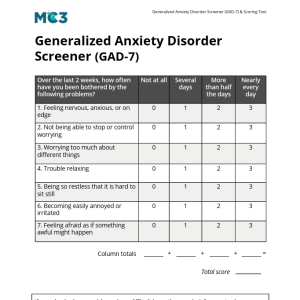
Generalized Anxiety Disorder (GAD-7) Screener & Scoring Tool
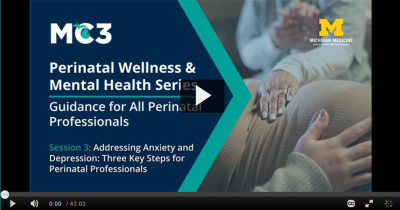
Video: Addressing Anxiety and Depression: Three Steps for Perinatal Professionals
Video: Postpartum (Perinatal) Anxiety and the Impact on the Child
Browse all Recorded Education Modules
Request a psychiatric consultation with MC3
For treatment guidance on a specific patient, outpatient prescribing health care providers can request a same-day consultation with MC3 psychiatrists.
No Comments |
Kara Kucinski |
- Sep 17, 2025
Depression Resources
Browse our collection of depression screening tools, treatment guidelines, and educational videos to support health care providers by navigating the tabs below.
For pediatric health care providers
Links to the following PDFs will open in a new tab when you click on them:
Behavioral Activation Ideas_TRAILS (PDF)
Behavioral Activation Schedule (PDF)
Building Happiness Exercises (PDF)
Coping Skills for Depression (PDF)
Cycle of Inactivity: TRAILS (PDF)
Depression in Children and Teens (PDF)
Links to the following PDFs will open in a new tab when you click on them:
Clinical Practice Guidelines for Children and Teens with Depression_AACAP (PDF)
Video: Depression in Youth: Presentation, Diagnosis, Treatment
For perinatal health care providers
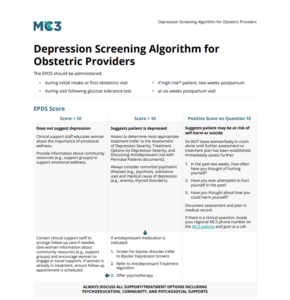
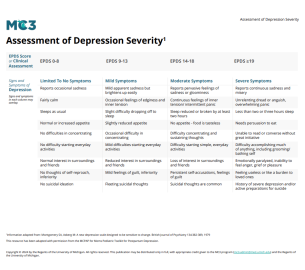
Depression Screening Algorithm for Obstetric Providers
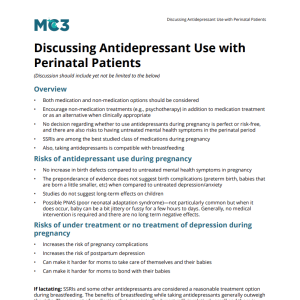
Discussing Antidepressant Use with Perinatal Patients
Video: Addressing Anxiety and Depression: Three Steps for Perinatal Professionals
Browse all Recorded Education Modules
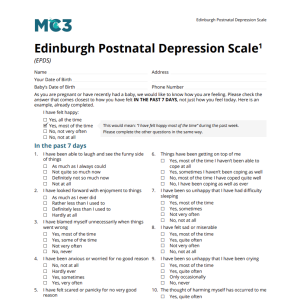
Edinburgh Postnatal Depression Scale
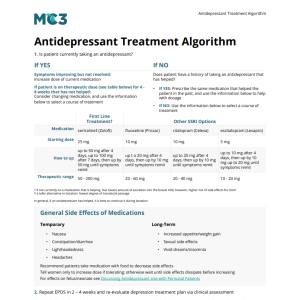
Antidepressant Treatment Algorithm
Request a psychiatric consultation with MC3
For treatment guidance on a specific patient, outpatient prescribing health care providers can request a same-day consultation with MC3 psychiatrists.
No Comments |
Kara Kucinski |
- Sep 17, 2025
Attention-Deficit/Hyperactivity Disorder (ADHD) Resources
Browse our collection of ADHD screening tools, treatment guidelines, and educational videos to support health care providers by navigating the tabs below.
For pediatric health care providers
Pediatric Resource Library: ADHD
Links to the following PDFs will open in a new tab when you click on them:
Common ADHD Medications & Treatments for Children (PDF)
Diagnosing ADHD in Children: Guidelines & Information for Parents (PDF)
Parenting Tips for Children with ADHD (PDF)
Sample Schedule for Kids with ADHD (PDF)
Tips for ADHD and School (PDF)
Understanding ADHD: Information for Parents (PDF)
The link to the following PDF will open in a new tab when you click on it:
Links to the following PDFs will open in a new tab when you click on them:
ADHD Clinical Guidelines McPAP (PDF)
Video: Clinical Pearls Video Series: Attention-Deficit/Hyperactivity Disorder
For perinatal health care providers
Request a psychiatric consultation with MC3
For treatment guidance on a specific patient, outpatient prescribing health care providers can request a same-day consultation with MC3 psychiatrists.
No Comments |
Kara Kucinski |
- Sep 17, 2025
Eating Disorder Resources
Browse our collection of eating disorder screening tools, treatment guidelines, and educational videos to support health care providers by navigating the tabs below.
For pediatric health care providers
Pediatric Resource Library: Eating Disorders
Links to the following PDFs will open in a new tab when you click on them:
Anorexia & Bulimia_How Eating Disorders Can Affect Your Child (PDF)
Eating Disorder Toolkit for Parents_National Eating Disorders Association (PDF)
Links to the following PDFs will open in a new tab when you click on them:
Video: Clinical Pearls Video Series: Eating Disorders Among Adolescents
For perinatal health care providers
Request a psychiatric consultation with MC3
For treatment guidance on a specific patient, outpatient prescribing health care providers can request a same-day consultation with MC3 psychiatrists.
No Comments |